
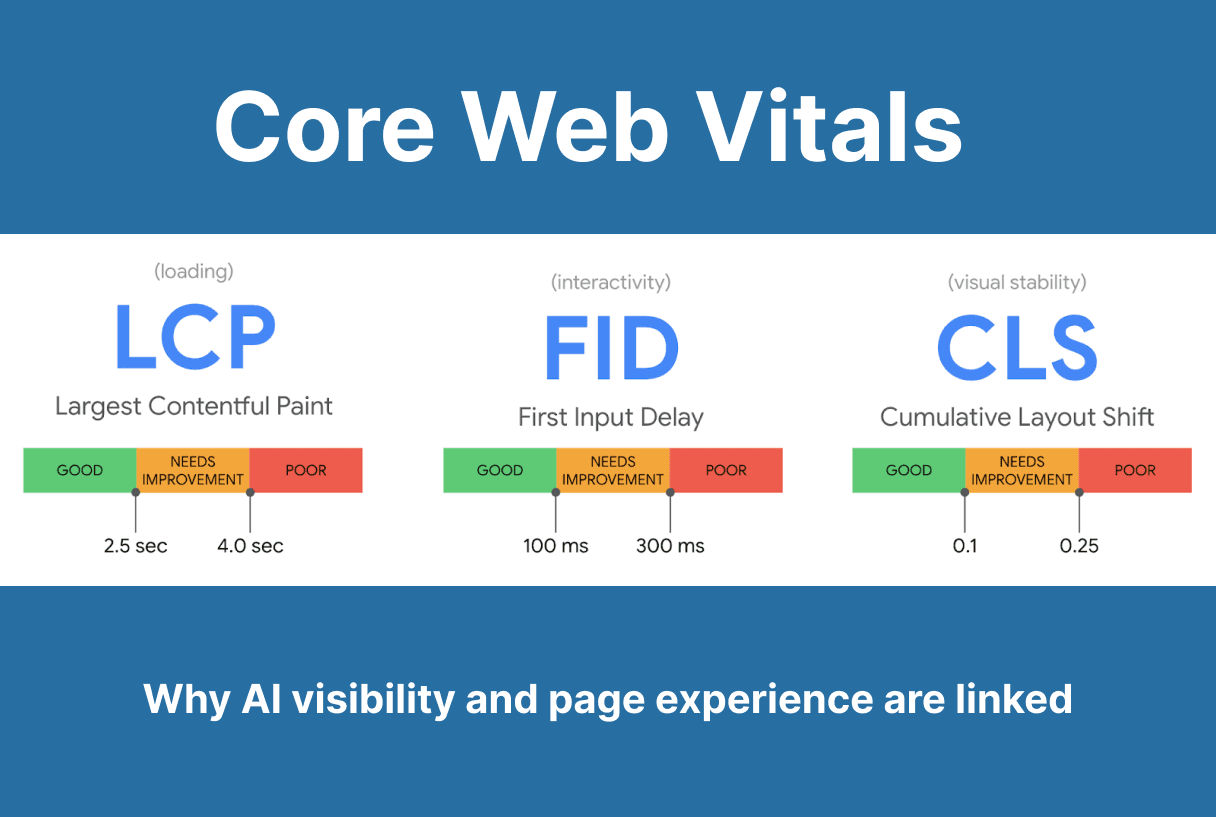
How page experience influences AI visibility
AI SEO: Improving Your Core Web Vitals Is Much More Important Now
For years, Core Web Vitals (CWV) felt like a box to check: pass the thresholds, avoid a penalty, move on. That mindset no longer holds. As LLMs become front doors to the web, page experience has quietly become part of the trust signal these systems use to decide who gets cited. Slow, unstable pages are increasingly left out of the conversation entirely.
Key Takeaways
Core Web Vitals function as a credibility gate for AI citations: sites that fail badly on speed or stability are far less likely to be surfaced by AI answer engines.
Fixing severe performance problems moves the needle far more than micro-optimizing an already-passing score
Interactive content consistently outperforms static blog posts on engagement and retention
Why Page Experience Is Tangled Up With AI Visibility
The instinct that "faster pages get cited more" is logical, but the evidence is more nuanced than a straight line. A large-scale analysis of over 107,000 pages appearing in Google AI Overviews, published on Search Engine Land, found only a weak correlation between CWV scores and AI visibility overall. But that weak average was misleading: the relationship was driven almost entirely by extreme outliers. Pages with badly failing metrics were penalized, while pages that merely met "good" thresholds saw little additional benefit from optimizing further.
The takeaway isn't that shaving another 200 milliseconds off an already-fast page will move rankings. It's that severe performance failures actively suppress AI visibility by undermining the engagement and trust signals these systems rely on. CWV now acts as a floor for inclusion rather than a lever for growth: strong content on a broken page still gets filtered out, while good-enough performance simply clears the way for content quality to do the real work.
Google's own AI features documentation doesn't list Core Web Vitals as a direct requirement for appearing in AI Overviews, and even Google's Danny Sullivan has framed the discipline more broadly, arguing that solid SEO practice generally lines up with what generative engines reward. In other words: performance failures get you excluded, but performance alone won't get you included.


A presentation slide from this year's Google Paris Search Live Central event highlights the importance of page experience for AI visibility.
Why Interactive Content Increasingly Outperforms Static Posts
If Core Web Vitals set the floor, engagement is what actually lifts a page above it: and this is where content format starts to matter. Multiple independent studies point to the same pattern: interactive formats like quizzes, calculators, assessments, and interactive infographics hold attention and drive action far more effectively than traditional static blog copy.
Data compiled by involve.me shows interactive content generates roughly 52.6% more engagement than static content on average, and that people spend around 53% more time with interactive formats than with passive ones. A study from Demand Gen Report also found interactive formats were markedly more effective than static content at actually educating buyers: a distinction that matters for AI systems, which increasingly weigh whether users get value from a page, not just whether they visit it.
This matters for AI visibility because generative engines are optimizing for the same underlying signal Google has chased for years: does this page genuinely satisfy the person who arrived there? Time on page, return visits, and low bounce rates are proxies for that satisfaction, and interactive content moves all three in the right direction.
A static blog article can explain a concept; an interactive calculator, comparison tool, or assessment lets the reader test it against their own situation. That difference in engagement is exactly the kind of signal that separates a page AI systems trust enough to cite from one they quietly skip.
Conclusion
The relationship between Core Web Vitals and AI visibility isn't as simple as "faster equals more citations," but it isn't irrelevant either. The data suggests a two-part strategy: first, eliminate severe performance failures, since those are what actively exclude pages from AI-driven answers; second, once your site clears that baseline, invest in the kind of content that genuinely interactive, engagement-driving formats — that gives AI systems a real reason to trust and recommend your page over a competitor's.
Speed gets you in the room. Content experience decides whether you get quoted.

